Islamic Binary Options Account
How halal binary options accounts work, which brokers offer genuine swap-free Islamic accounts, and what Sharia compliance means in practice for Muslim traders.
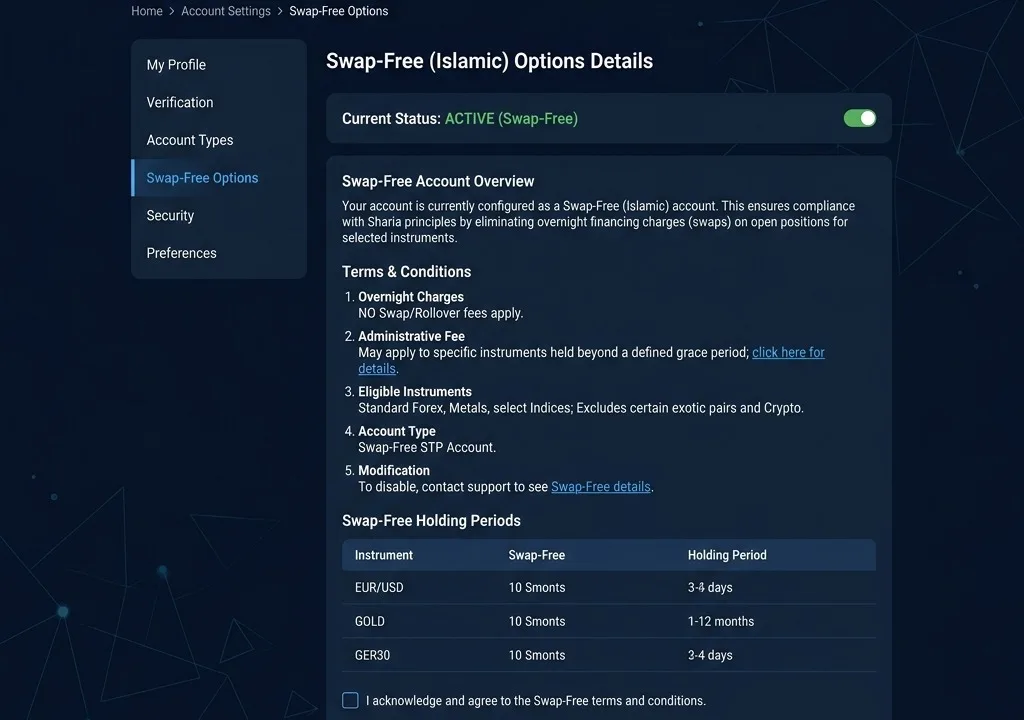
What is an Islamic Binary Options Account?
An Islamic binary options account — often referred to by brokers as a swap-free account or halal account — is an operational account configuration designed to eliminate overnight rollover interest charges. These accounts are created for traders who observe Islamic financial principles, which strictly prohibit usury and interest-bearing transactions.
Islamic jurisprudence evaluates financial contracts against three fundamental prohibitions derived from the Quran and Sunnah: riba (the charging or paying of interest), gharar (excessive ambiguity, uncertainty, or speculative risk), and maysir (gambling or games of pure chance). Conventional derivative accounts typically charge overnight financing fees (swaps), which directly contravene the prohibition of riba.
However, traders must understand that an operational swap-free feature is not equivalent to religious certification. While removing overnight fees addresses riba, leading Islamic jurisprudence bodies—including the International Islamic Fiqh Academy and national Shariah advisory councils—have raised serious structural concerns regarding binary options contracts themselves, viewing fixed-odds digital contracts as carrying unresolved gharar and maysir due to the absence of underlying asset ownership or physical delivery. Muslim traders should examine these jurisprudential perspectives carefully before trading.
How Halal Binary Options Accounts Work
Brokers offering Islamic or swap-free accounts adjust specific operational mechanics to address standard interest-related objections. Here is how these mechanisms function in practice and where structural limitations remain.
Elimination of Riba (Overnight Swaps)
In conventional trading, keeping leveraged positions open past the daily market cut-off triggers overnight rollover interest charges (swap fees). In swap-free accounts, brokers waive these fees. Some brokers charge a fixed administrative fee or wider spreads instead, but this fee must remain flat and disconnected from loan amounts or durations to satisfy riba guidelines.
The Gharar (Excessive Uncertainty) Question
Gharar refers to excessive ambiguity in a commercial transaction—such as selling an item that cannot be delivered. In binary options, contract parameters (stake, expiry, and advertised payout) are fully known upfront. However, many Islamic jurists argue that because binary options do not transfer ownership of any underlying currency, stock, or commodity, the contract represents an agreement on future price uncertainty rather than a bona fide commercial sale.
The Maysir (Wagering) Question
Maysir prohibits transactions structured as games of chance where one party gains entirely at the direct financial loss of another without underlying economic exchange. Proponents argue that market participants using economic data and technical charting are conducting skilled analysis rather than gambling. Conversely, institutional Islamic scholars frequently point out that the all-or-nothing payout structure of binary options mathematically mirrors wagering mechanisms.
Operational Features vs. Formal Sharia Certification
Most retail brokers advertise "Islamic accounts" solely as a commercial feature that disables swap charges. A genuine Sharia-compliant product, by contrast, requires comprehensive auditing and ongoing supervision by an independent, accredited Sharia supervisory board. Very few offshore binary brokers hold formal Sharia certification; traders should not mistake a marketing label for a formal religious ruling.
Brokers with Swap-Free & Islamic Account Options
The following international platforms offer documented swap-free account configurations for traders in eligible regions. Note that these represent operational swap-free features rather than universal Sharia endorsements.
Quotex does not levy overnight rollover interest or swap charges on standard digital option contracts, providing an automatic swap-free operational environment. The platform offers access to 400+ assets with a $10 minimum deposit and a $1 minimum trade size. Note that Quotex operates under offshore commercial registration in St. Kitts and Nevis and does not carry an independent Sharia supervisory board certification.
Read Full Review →IQ Option provides swap-free account settings for eligible international clients upon request. For traders outside the European Economic Area accessing binary options, the operating company is SKY LADDER LLC (Antigua and Barbuda; CySEC licence 247/14 applies exclusively to EU CFD entities under IQBroker Europe Ltd and does not cover offshore binary accounts). The platform features an extensive 13-year operational history, $10 minimum deposit, and responsive charting.
Read Full Review →AvaTrade is a globally regulated CFD brokerage (holding licences with ASIC, CBI, and FSCA) that provides dedicated Islamic swap-free accounts with zero overnight fees on major financial instruments. Because CFDs are continuous contracts with variable leverage rather than all-or-nothing bets, some traders consider them distinct from binary options; however, CFDs carry substantial risk of rapid loss where the majority of retail investor accounts incur net capital losses when trading with leverage.
Read Full Review →Pocket Option offers swap-free binary options trading with broad cryptocurrency funding rails and a $50,000 practice demo. The platform is operated by Infinite Trade LLC with commercial incorporation in Costa Rica and an unverified MISA licensing claim. It does not carry independent Sharia supervisory board governance, and traders should evaluate offshore risks carefully.
Read Full Review →Country-Specific Considerations for Muslim Traders
The regulatory status of binary options and the practical availability of Islamic accounts varies significantly by country. Some nations have robust local regulations governing what is permissible; others rely primarily on overseas regulatory frameworks. Click your country below for specific guidance.
It is important to verify local laws before opening any trading account. In some Gulf Cooperation Council (GCC) countries, online trading is subject to financial authority oversight, and some types of speculative contracts may be restricted. Always consult a qualified Islamic finance scholar if you have questions about the permissibility of a specific trading structure in your country.
Frequently Asked Questions
Q: Are binary options considered halal or haram in Islamic jurisprudence?
There is significant division among Islamic scholars and jurists regarding binary options. Prominent institutions such as the International Islamic Fiqh Academy and national Shariah advisory councils view retail binary options with severe concern, classifying fixed-odds digital contracts as resembling wagering (maysir) with excessive uncertainty (gharar) due to the absence of underlying asset ownership or physical delivery. Conversely, some retail participants argue that when overnight rollover interest (riba) is eliminated via swap-free mechanisms and trades rely on systematic technical analysis, the activity differs from casino gambling. Because eliminating swap fees does not resolve all structural objections, Muslim traders must seek individualized guidance from a qualified Islamic finance scholar.
Q: What is the difference between a swap-free account and a certified Islamic account?
A swap-free account is an operational accommodation provided by a broker that eliminates overnight rollover interest fees (riba). However, a swap-free feature is not equivalent to religious certification. A genuine Sharia-compliant financial arrangement typically requires formal audit and ongoing supervision by an accredited, independent Sharia supervisory board to ensure the entire contract structure, fee schedule, and underlying assets comply with Islamic law. Most offshore binary brokers provide operational swap-free toggles without independent Sharia board oversight.
Q: Do swap-free accounts resolve all religious objections to binary options?
No. While swap-free accounts eliminate overnight financing fees (riba), they do not resolve broader jurisprudential questions concerning gharar (excessive ambiguity) and maisir (speculative wagering). Because binary options involve all-or-nothing payouts tied to short-term price movements without asset transfer, many Islamic scholars consider the core contract structure impermissible regardless of whether overnight interest is eliminated.
⚠️ Risk Warning
Binary options trading involves significant risk of loss. Even with an Islamic account, you can lose all funds invested in a single trade. The majority of retail binary options traders lose money. This content is for educational purposes only and does not constitute financial or religious advice. Religious permissibility is a personal matter — consult a qualified Islamic finance scholar before trading. Never trade with money you cannot afford to lose. Return to homepage.