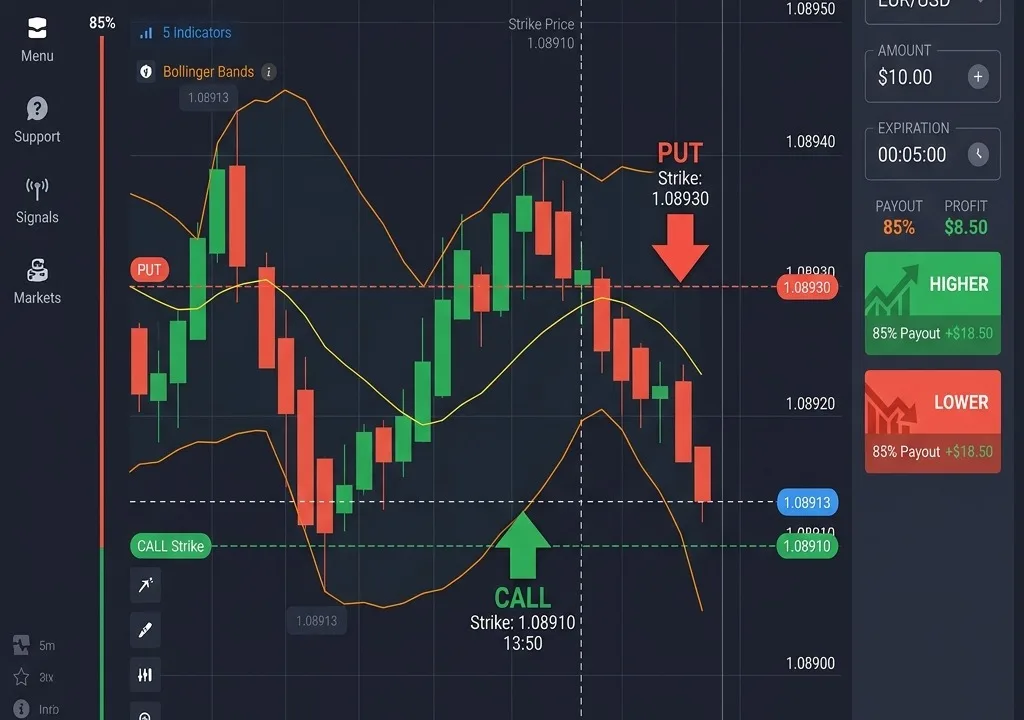
A binary option is an all-or-nothing derivative contract where the financial return is predetermined from the moment an order is submitted. Unlike traditional stock purchases or CFD positions where profit or loss expands depending on how far the market travels, a binary contract resolves to only two possible outcomes at expiration: a fixed percentage return on your invested capital, or the complete loss of your initial trade stake. Before risking capital, test execution on a free binary options demo account and review critical trading mistakes to avoid. For specific asset classes, explore our guides on stock binary options and commodity trading brokers.
Step-by-Step Guide
- 1
Understand the All-or-Nothing Settlement Payoff
Every binary options trade requires you to predict whether the price of an asset will finish above or below a chosen benchmark (the strike price) at an exact future moment. Throughout our analysis, "payout" specifically denotes the net profit percentage returned above the original stake upon a winning outcome. For example, on a $100 stake with an 80% quoted payout, a winning contract returns the $100 principal plus an $80 net profit component (a total returned sum of $180). Conversely, if the price moves against you by even a single pip at expiry, 100% of the invested trade stake is forfeited ($0 returned). You cannot suffer a margin call or incur debt beyond your stake, but you cannot capture larger returns if the market trends aggressively in your favor.
- 2
Calculate the Negative Mathematical Expectancy
The central economic characteristic of fixed-odds binary contracts is asymmetrical payoff. Under the standard retail model—assuming a fixed stake per trade and a payout of 80% on winning contracts alongside a 100% loss on unsuccessful contracts—a 50% win rate yields a negative mathematical expectancy: for every two trades ($10 win returning $8 profit and $10 loss), the net result is a $2 deficit. To achieve mathematical break-even under these specific contract assumptions, a trader's win rate must exceed 55.56% (derived from the break-even formula: 1 / (1 + payout) = 1 / 1.80). If a contract pays 75%, the required threshold rises to 57.14%; if it pays 90%, the threshold drops to 52.63%. Expectancy varies dynamically across assets, sessions, and contract types rather than remaining static, but the sub-100% payout structure consistently establishes an asymmetrical hurdle for retail participants.
- 3
Distinguish Between Spot Markets and Synthetic OTC Feeds
During standard global exchange hours (Monday through Friday), binary platforms generally peg their quote feeds to interbank spot forex and spot commodity prices. However, on weekends or during off-peak market hours, many retail brokers offer OTC (Over-The-Counter) binary options. OTC contracts are priced using internal broker algorithms rather than live interbank exchange orders. While OTC contracts enable 24/7 trading, traders must recognize that pricing is synthetic and cannot be cross-referenced against external public exchanges.
- 4
Select Credible Platform Infrastructure and Verify Entities
Because retail binary options are prohibited across tier-1 regulatory jurisdictions—including the European Union under ESMA Product Intervention Decision 2018/796 (subsequently enacted by national competent authorities), the United Kingdom under FCA Policy Statement PS19/18, and Australia under ASIC Corporations Instrument 2021/240—most platforms accepting international retail traders operate from offshore commercial jurisdictions such as St. Kitts and Nevis, Antigua and Barbuda, St. Vincent and the Grenadines, or Costa Rica. Before depositing funds, traders must verify the legal operating entity, fee schedules, withdrawal conditions, and whether the platform maintains voluntary private dispute resolution (such as Category A membership in The Financial Commission). Review our objective review methodology and broker analyses before committing capital.
- 5
Compare Binary Options vs Forex and CFD Trading Mechanics
Neither binary options nor CFD and forex trading should ever be characterized as low-risk financial products. In retail CFD and forex trading, profit and loss are continuous—expanding or contracting based on price distance, position volume, and leverage ratios. Regulatory disclosures from tier-1 oversight bodies consistently document that 70% to 80% of retail CFD accounts incur net losses. In contrast, binary options enforce a capped, fixed return regardless of whether the market moves one pip or one hundred pips, combined with a 100% forfeiture of the trade stake if the market finishes out of the money. Furthermore, binary contracts carry an inflexible time expiry, preventing traders from holding underwater positions until market conditions recover.
- 6
Apply the 1% to 2% Capital Preservation Rule and Avoid Martingale
Due to the fixed-loss nature of binary contracts, variance and drawdown streaks are inevitable even within robust trading systems. Sound capital preservation mandates that no individual trade should risk more than 1% to 2% of total account equity. Crucially, traders must reject Martingale progression strategies (doubling trade stakes after each consecutive loss to recoup deficits). Because binary options feature sub-100% payouts alongside total loss on losing trades, a string of consecutive losses rapidly forces trade sizes into exponential territory, invariably exhausting account margin and triggering total balance liquidation.
- 7
Build System Discipline on a Free Demo Account
Never begin trading binary options with live capital. Reputable platforms provide free, replenishable demo accounts funded with virtual balances (ranging from $1,000 to $10,000). Use a demo account to verify order execution speed, chart readability, and asset availability across different market sessions. Track at least 50 to 100 virtual trades across varying volatility conditions to verify that your win rate consistently clears the mathematical break-even threshold.
Frequently Asked Questions
What is the minimum deposit and trade size for binary options?+
Most major international binary options brokers set accessible entry requirements. Minimum deposits typically start at $10 on platforms like Quotex and IQ Option, with minimum trade stakes starting at $1 per contract. Platforms like Pocket Option advertise deposits starting from $5, though minimum requirements can reach $50 depending on the selected payment method and country. Beginners should always test platforms with free virtual demo accounts before making an initial deposit.
Are binary options the same as gambling?+
While binary options share a fixed-odds payoff structure similar to betting, they differ in how probabilities are determined. Gambling outcomes (such as roulette or dice) rely on fixed random distribution. In contrast, financial asset prices reflect macro economic data, market liquidity, and technical support and resistance levels. However, placing binary trades without an objective technical strategy, economic calendar awareness, or position sizing is functionally indistinguishable from gambling.
Why do payout rates fluctuate throughout the trading day?+
Advertised payout rates (such as 85% or 92%) are dynamic figures set by the broker based on market liquidity, asset volatility, and platform exposure. During high-volume market hours (such as the London and New York session overlap), liquidity on major currency pairs like EUR/USD is deep, allowing brokers to offer higher payouts. During thin Asian sessions or right before major economic releases, payouts often contract to reflect elevated counterparty risk.
Can you trade binary options legally in the US, UK, and Europe?+
Statutory regulations vary significantly by jurisdiction. In the United Kingdom (FCA), European Union (ESMA), and Australia (ASIC), offering binary options to retail clients is prohibited under investor protection intervention mandates. In the United States, offshore retail binary platforms are illegal, but exchange-traded binary options are legally permitted through CFTC-regulated domestic exchanges like Nadex. In many parts of Asia, Africa, and Latin America, residents may legally access international offshore platforms at their own discretion.
How long does it take for a beginner to become consistently profitable?+
Statutory regulatory findings—including European Securities and Markets Authority (ESMA) retail product intervention studies (Decision 2018/796)—found that between 74% and 89% of retail binary options client accounts experienced net capital losses. In educational literature, achieving consistency requires developing technical chart reading, understanding session liquidity, and mastering emotional discipline. Experienced educators recommend spending a minimum of three to six months practicing on a free demo account and keeping a detailed trade journal before committing live funds.
What is the most reliable strategy for binary options trading?+
The most sustainable retail approaches focus on trend continuation and key horizontal support and resistance levels on 5-minute to 15-minute price charts during active market hours. Traders typically wait for price to test a verified historical zone, observe confirmation through candlestick patterns or volume indicators, and enter with an expiry equal to 2 to 3 chart candles. Avoid 30-second turbo expiries, which are dominated by random market noise.
How do binary options differ from CFD and forex trading?+
In CFD and forex trading, your financial gain or loss is variable and expands depending on how many points or pips the market moves relative to your position size and leverage. In binary options, whether price moves by one pip or one hundred pips, the payoff is identical and capped at the fixed contract percentage. Furthermore, binary options have a rigid time expiration, whereas CFD positions can be held indefinitely as long as margin requirements are satisfied.
Essential Resources & Next Steps
Before risking real capital on any binary options contract, develop execution discipline and review our regulatory and testing frameworks: