Binary Options Demo Account
Compare free demo accounts from the top binary options brokers. Discover how much virtual capital is provided, how expiry conditions operate, and how to practice methodically before committing real capital.
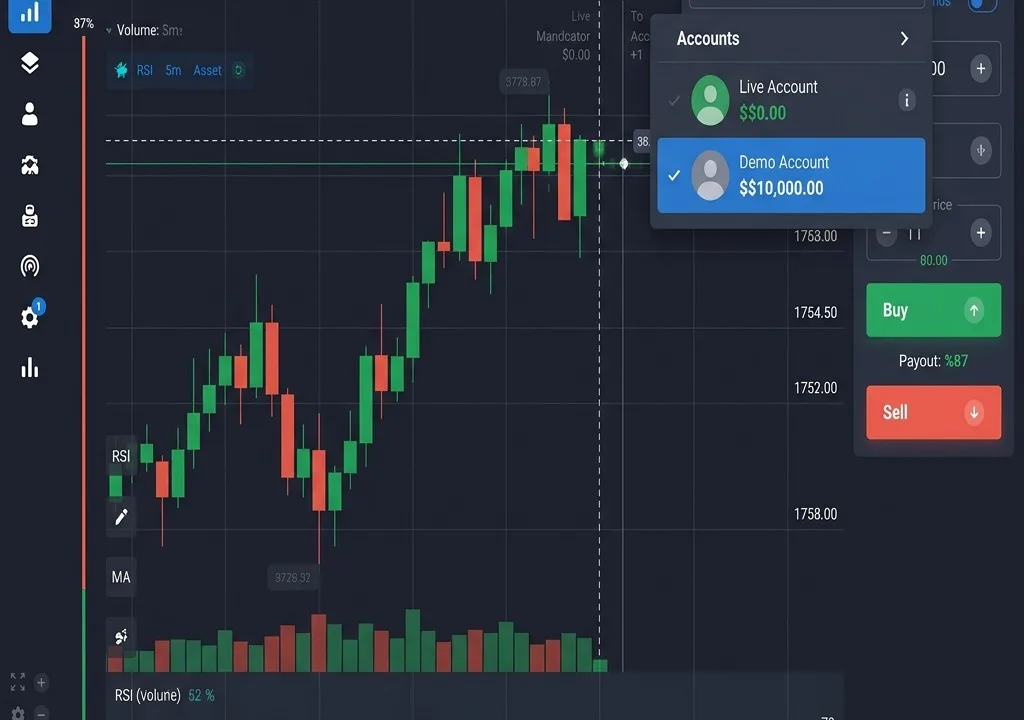
Why Use a Binary Options Demo Account?
A binary options demo account provides access to a fully functional trading interface loaded with virtual currency—requiring zero initial capital deposit. It allows traders to observe real-time price feeds, practice order entry, and test strategy rules without financial exposure. However, while demo environments replicate charting and contract mechanics, they cannot simulate live execution latency, slippage, liquidity queues, emotional discipline under real financial loss, or broker withdrawal reliability. Treat demo trading strictly as a procedural sandbox rather than proof of live market profitability.
For novice traders, a demo environment is essential. While binary options contracts appear straightforward—predicting whether an asset will settle above or below a strike price at expiration—consistently achieving a positive mathematical expectancy demands rigorous risk control, emotional neutrality, and an understanding of payout math. A demo account provides the procedural sandbox necessary to build these fundamentals before capital is committed.
Zero Capital at Risk
Execute trades freely in a simulated environment without risking real savings. Master order entry mechanics and button placement before funding an account.
Test Strategy Logic
Evaluate specific technical triggers, indicator setups, and session timeframes across live price data to observe trade distribution and variance.
Learn the Interface
Familiarize yourself with chart timeframes, indicator templates, one-click execution controls, and expiration selectors under market conditions.
Verify Break-Even Math
Track your win rate across 100+ sample trades. In binary options, an 80% payout requires a 55.6% win rate just to break even.
Best Free Binary Options Demo Accounts
Below is an objective comparison of the leading binary options demo platforms. Each provider allows free registration without requiring payment credentials to initiate simulated practice.
| Broker | Virtual Funds | Deposit Required? | Time Limit | Assets |
|---|---|---|---|---|
| Quotex | $10,000 | No | Unlimited | 400+ |
| IQ Option | $10,000 | No | Unlimited | 300+ |
| Pocket Option | $50,000 | No | Unlimited | 100+ |
| Binomo | $1,000 | No | Unlimited | 70+ |
| Olymp Trade | $10,000 | No | Unlimited | 100+ |
| ExpertOption | $10,000 | No | Unlimited | 100+ |
| Exnova | $10,000 | No | Unlimited | 250+ |
Quotex provides a $10,000 replenishable virtual balance requiring only an email to initiate. The web interface mirrors live platform charts, technical indicators, and drawing tools. Advertised payouts reach up to 95% on select high-liquidity currency pairs during peak market hours, though typical daytime returns fluctuate between 80% and 88%. Simulated trades execute without real-world latency or order queueing, meaning fills are instantaneous.
Read Full Review →IQ Option offers a $10,000 replenishable demo account alongside multi-chart layouts, extensive technical indicators, and historical volatility widgets. It provides an excellent environment for structured technical analysis. Note that while IQBroker Europe Ltd (formerly IQOption Europe Ltd) holds CySEC licence 247/14 for EU retail CFD services under the trade name IQBroker, binary options accounts for international clients are operated by SKY LADDER LLC (Antigua and Barbuda; historically referenced under St. Vincent corporate structures) without European statutory investor compensation schemes.
Read Full Review →Pocket Option equips demo accounts with $50,000 in virtual funds, allowing traders to test higher nominal position sizes and evaluate longer expiration periods. The platform includes automated copy trading and social feeds on live accounts; however, traders should exercise extreme caution with copy signals, as shared community accounts frequently employ high-risk martingale escalation strategies that lead to severe drawdowns.
Read Full Review →Binomo provides a $1,000 demo account, deliberately sized to reflect realistic retail starting deposits. This smaller balance discourages reckless oversized betting and encourages conservative 1% to 2% position sizing. However, Binomo features a lower advertised maximum payout ceiling of 87% on standard accounts, requiring a higher win rate (over 53.5%) to offset losses compared to higher-payout competitors.
Read Full Review →Olymp Trade provides a $10,000 virtual balance to test its dual Fixed Time Trading (FTT) and forex modes. The platform features an extensive built-in educational curriculum and technical strategy webinars.
Read Full Review →ExpertOption allows immediate demo trading with $10,000 in virtual funds without mandatory account verification, specializing in short-duration equity and digital currency contracts.
Read Full Review →Exnova delivers a modern web and mobile charting terminal equipped with a replenishable $10,000 practice account, sharing interface ergonomics with top-tier multi-asset platforms.
Read Full Review →How to Get the Most from Demo Trading
Most traders waste their demo account. They trade randomly, ignore their results, and use it as entertainment rather than education. Here is how to use demo trading effectively so that the transition to live trading is as smooth as possible.
Treat Every Demo Trade as if It Were Real
The biggest mistake in demo trading is taking risks you would never take with real money — oversizing positions, revenge-trading after losses, or randomly clicking buy/sell. Force yourself to follow the same rules you intend to use on a live account. If you would not risk 20% of your live account on a single trade, do not do it on demo either.
Keep a Detailed Trade Journal
Record every single demo trade: the asset, the direction, the expiry, your rationale, the outcome, and your emotional state. After 50–100 trades, review your journal to identify patterns. Are certain assets more predictable for you? Certain times of day? Certain expiry lengths? This data is worth more than any trading course.
Focus on Win Rate and Return, Not Profit
In binary options, profitability depends on both your win rate and the payout percentage. If the platform pays 80% on wins and loses 100% on losses, you need to win more than 55.5% of your trades to break even. Calculate your break-even win rate based on the broker's payouts and ensure your demo results consistently beat it before going live.
Test One Strategy at a Time
Do not try to learn five strategies simultaneously. Pick one — for example, trading a 5-minute RSI signal on EUR/USD — and execute it consistently for at least two to three weeks. Only move on once you have enough data to assess whether it has a genuine edge.
Simulate Realistic Deposits
If you plan to start live trading with $200, set your demo account to trade as if you only have $200, even if you have $10,000 of virtual funds. This forces you to practise position sizing and risk management that is actually relevant to your real situation.
When to Switch from Demo to Real Account
There is no universal answer to when you should move from demo to live trading, but there are specific milestones to aim for before making the switch.
A commonly recommended benchmark is a minimum of 100 demo trades with a documented win rate that comfortably exceeds your break-even threshold for at least 30 consecutive days. This removes the possibility that a short lucky streak is masking an unprofitable strategy.
You should also be able to articulate exactly why you are taking each trade— not just that the chart "looks right." A well-defined entry signal, a clear asset selection rationale, and a predetermined position size are all signs that you are ready to go live.
When you do make the switch, start with the minimum deposit and minimum trade size. Real money will feel very different from demo, and your first few weeks of live trading are really an extension of your learning period, not a phase where you should be expecting significant returns.
Demo vs Real: Key Technical & Psychological Differences
While modern demo software visually duplicates live trading terminals, critical structural and behavioral differences distinguish simulated trading from deploying real capital.
Demo Environment
- ✓ Virtual capital with zero balance consequence
- ✓ Instantaneous order fills without liquidity constraints
- ✓ Zero emotional friction during drawdowns
- ✓ Email-only signup without regulatory KYC requirements
- ✓ Absence of capital withdrawal considerations
Live Trading Reality
- ! Irreversible capital loss on negative contract outcomes
- ! Potential execution latency during volatile market releases
- ! Psychological pressure causing premature or emotional exits
- ! Mandatory identity and proof-of-address verification (KYC)
- ! Payment processing timelines and minimum withdrawal limits
1. Synthetic OTC Feeds vs Live Spot Markets
When practicing during weekend sessions, brokers switch currency pairs to Over-the-Counter (OTC) feeds. OTC feeds are synthetically generated by internal broker algorithms rather than aggregated from institutional interbank liquidity pools. Strategies refined on weekend OTC charts frequently fail during standard weekday sessions due to differing volatility patterns and genuine macroeconomic catalysts.
2. Execution Latency and Server Queueing
Demo trades are executed locally against simulated pricing servers where virtual orders are accepted instantaneously. On live accounts, high-frequency price movement around major economic announcements (such as US Non-Farm Payrolls or central bank rate decisions) can introduce millisecond transmission delays. In 60-second binary contracts, even slight latency can dramatically shift the entry strike price.
3. The Psychological Reality of Real Capital
Virtual funds insulate traders from the visceral stress of seeing account equity decline. A trader who comfortably holds through a 5-trade losing streak on demo often abandons their strategy, panics, or engages in revenge trading when real capital is diminished. For detailed guidance on preventing emotional errors, consult our guide on mistakes to avoid in binary options trading.
How We Evaluate Demo Accounts & Trading Platforms
Our editorial evaluations are governed by an objective framework assessing platform stability, pricing feed transparency, regulatory jurisdiction, and fee disclosures. We do not accept payment to elevate broker placements or manipulate comparison rankings. For complete transparency on our scoring rubrics and commercial partnerships, explore our structural disclosures:
Frequently Asked Questions
Q: Do binary options demo accounts have a time limit?
Mainstream platforms including Quotex, IQ Option, and Pocket Option offer unlimited demo accounts with no expiration date. You can trade simulated funds indefinitely without submitting deposit credentials. If your virtual balance is depleted, most platforms allow a single-click reset to replenish the default amount.
Q: Is demo trading identical to real-money trading?
Demo accounts simulate identical price charting and advertised payout rates, but execution differs in two critical ways: demo trades fill instantly without order queueing latency, and simulated trades carry zero emotional risk. Treat demo accounts as a mechanical training sandbox rather than a financial predictor.
Q: How much virtual money do binary options demo accounts provide?
Default allocations vary by broker. Pocket Option allocates $50,000, Quotex and IQ Option provide $10,000, and Binomo assigns $1,000. While larger balances allow higher trade sizes, beginners benefit from treating virtual funds as if they represent a modest real-world starting balance (such as $200 to $500).
Q: Can you withdraw profits earned on a binary options demo account?
No. Demo funds are strictly virtual credits and possess no monetary value. Any promotional service, signal channel, or third-party website claiming you can "withdraw demo profits" upon paying an activation or unlocking fee is an advance-fee scam.
Q: Do demo accounts operate on weekend OTC markets?
Yes. Most platforms maintain active demo trading over weekends via synthetic OTC (Over-the-Counter) pricing feeds. However, because OTC price action is generated by internal broker algorithms rather than interbank foreign exchange networks, traders should be cautious about translating OTC weekend back-test results to weekday market sessions.
⚠️ Capital Risk Warning
Binary options trading involves substantial risk of financial loss. While a demo account carries zero financial exposure, real trading can result in the rapid loss of your entire deposited capital. Past performance in a virtual simulated environment does not guarantee equivalent outcomes with live capital. The majority of retail binary options accounts incur net losses. This material is provided strictly for educational purposes and does not constitute investment advice. Never trade with capital you cannot afford to lose in full. Return to homepage.